
On a warm January morning, at the height of southern hemisphere summer, I drove to a small print workshop on the edge of Sydney.
The roller door was already open.
The air smelled like paper and ink.
Old machines. Oil. Heat.
The kind of place where things are made, not presented.
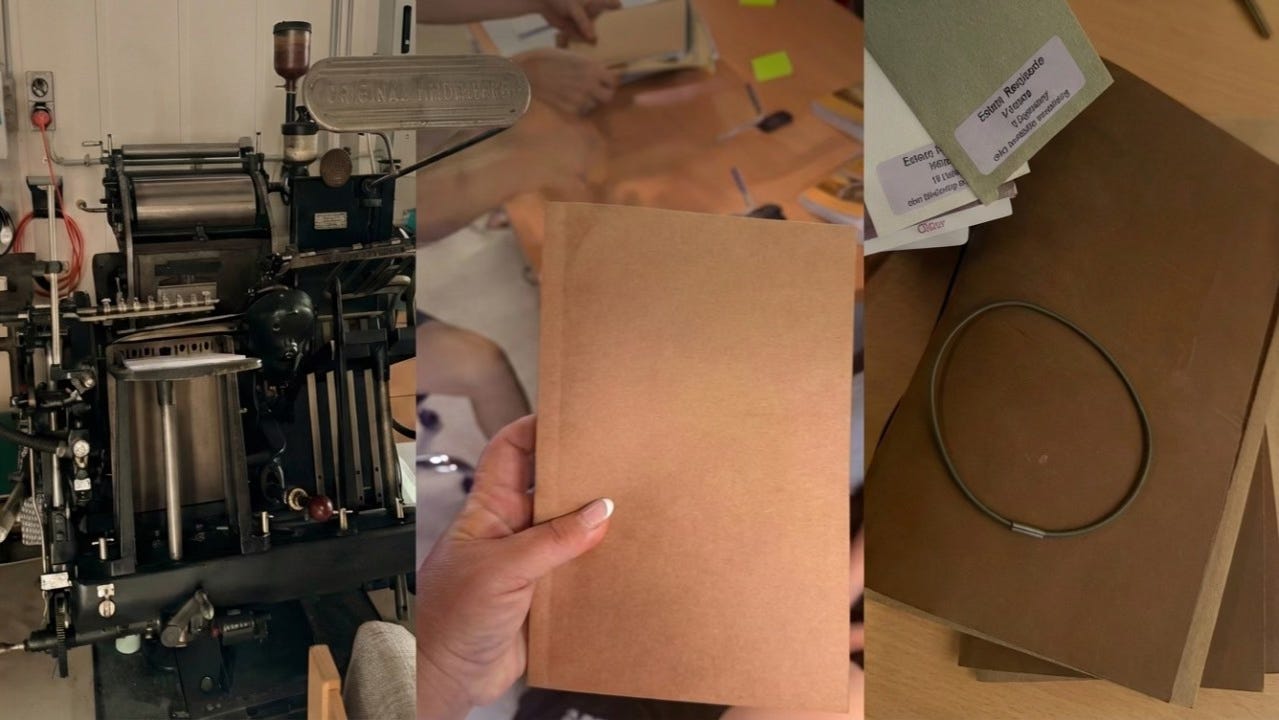
For the past year, I’ve been writing about operating at the edge of tech-driven change while living it as a CEO in Australia. Building an AI-native operating model. Working day to day with my AI Chief of Staff. Making decisions at a pace institutions were never designed to match.
Most of that work happens on screens.
Prompts. Dashboards. Threads.
Drafts that can always be revised.
Standing there, that stopped.
I wasn’t choosing words anymore.
I was choosing paper.
Earthy recycled stock. Green, flecked, imperfect. I ran my fingers over it. Dry. Textured. Honest. It smelled faintly of cardboard and ink.
We talked weight.
80 or 90gsm for the interior, so the book would open and move properly.
209gsm for the cover, so it would hold its shape without becoming rigid.
Every choice had a consequence.
Too heavy and the book becomes stiff.
Too light and it feels disposable.
No option to iterate later.
That’s when it landed in my body.
This is what authorship actually feels like.
In my work with AI, friction disappears quickly. Outputs appear instantly. Systems move by default. Decisions can feel as though they’re happening on their own.
But authorship only shows up when something has to hold.
When a decision can’t be softened later.
When a choice excludes other choices.
When someone is accountable for coherence, not just contribution.
Paper makes that unavoidable.
The press prints exactly what you give it.
Not what you intended.
Not what you meant and can revise later.
What you chose.
Alongside the book, I’m ordering kraft folders to encase the Field Notes section. Deliberately temporary. Meant to be opened, worked with, replaced.
And for those who want something that holds over time, a leather cover. A permanent artefact. Not default. Chosen.
Even here, authorship shows up as a decision about what should endure, and what should stay workable.
EDGE is almost ready to leave my hands.
It now exists in paper, weight, and binding, not just in drafts and on screen. It’s being published with Aburra Press, alongside my publishing collaborator Barry, who has helped shepherd its final form.
If you want to go deeper, the book is titled:
EDGE: A Field Guide for Navigating Tech-Driven Change
The waitlist is open at edge.guide.
To the edge and beyond. See you out there!
Kate